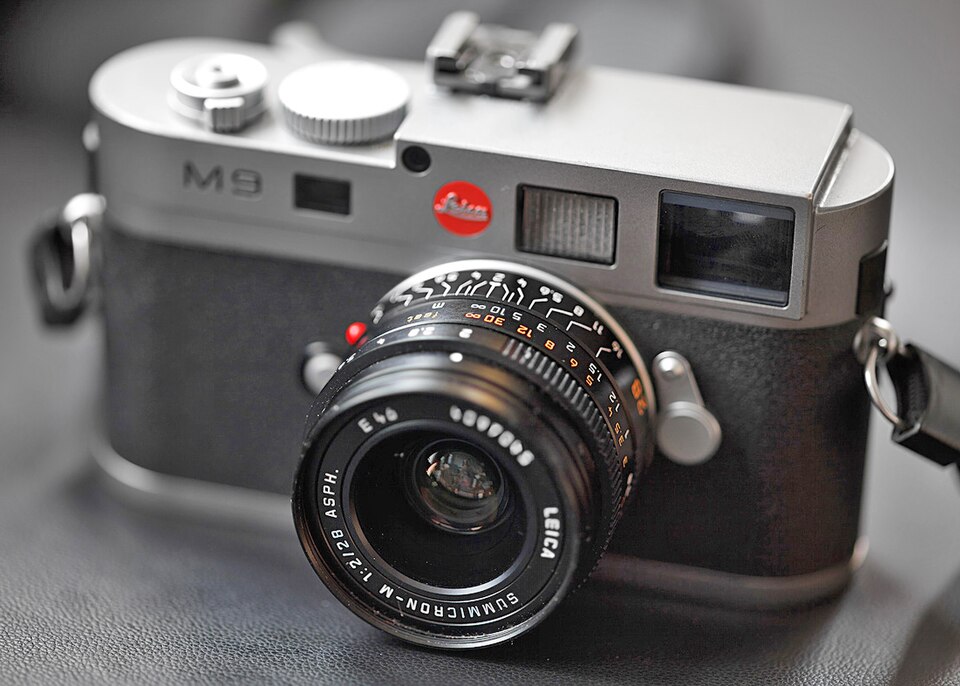
Leica M9
Iconic CameraThe M9 was the first full-frame digital rangefinder ever made. Its Kodak CCD sensor produced a color rendering — the "CCD look" — that many photographers still prefer over modern CMOS bodies, and it proved that the M system could make the digital transition without losing its soul.
Famous for
- The first full-frame digital rangefinder — Leica's proof that the M could go digital without compromise
- CCD sensor rendering beloved by photographers despite later corrosion issues
Introduced on 9 September 2009 — the "09/09/09" event in New York — the Leica M9 was a genuinely historic camera: the first full-frame (24×36mm) digital rangefinder ever made. It used an 18-megapixel Kodak KAF-18500 CCD sensor — not CMOS, CCD — and that choice defined its character. CCD sensors render color and tonal gradations differently from CMOS, producing what photographers call the "CCD look": rich, slightly saturated color, a particular film-like rendering in highlights, and a quality that many Leica shooters still prefer over the newer CMOS M bodies.
For anyone coming from modern mirrorless cameras: the M9 was primitive by today's standards — no video, slow LiveView, a sensor that developed corrosion issues in later units — but its images had a quality that made people overlook every limitation. At $6,995, it was expensive, but it delivered something no other camera could: a true full-frame rangefinder experience. Leica offered a free sensor replacement program for affected units. Working M9s with replaced sensors remain sought-after today, especially among photographers who prefer CCD rendering. It proved that the M system had a digital future, and it set the template for every digital M that followed.
Key specs
- type
- full-frame digital rangefinder
- sensor
- 18MP Kodak KAF-18500 CCD, 24×36mm
- iso range
- ISO 80–2500
- finder magnification
- 0.68x
- shutter
- cloth focal-plane, 8s–1/4000
- storage
- SD card
Variants & finishes
The original M9 launch finish: grey-painted top and bottom plates over a black vulcanite body. Unique to the first-generation M9 and the color most associated with its debut.
Traditional black-lacquer finish over brass — the M9 version that shows brassing on edges over time. A more classic look on a digital body.
Sapphire LCD cover glass and no red Leica dot on the front — a discreet, slightly more refined version aimed at working photographers who prefer an understated look.

Limited-edition titanium-finished body designed in collaboration with Walter de'Silva. Collectible and rarely used — more of a display piece than a shooter's camera.

Leica M9 / M9-P / M-E (Typ 220) Buyer Guide
Collector & User Inspection Guide
CCD Sensor Corrosion / Delamination
The Kodak KAF-18500 CCD cover glass corrodes over time, causing permanent white dots/ring artifacts at small apertures (f/8+). Check service menu or invoice: Sensor ID 11, 15, or 16 means the upgraded, corrosion-free glass has been fitted by Leica (CCD ID 15/16) or reputable repair labs (Kolari/MaxMax). Avoid unreplaced original sensors unless priced for sensor replacement.
Mainboard & SD Card Compatibility
The M9 processor is slow and picky with modern high-speed SD cards. Use SanDisk Extreme Pro 16GB/32GB (SDHC Class 10 / UHS-I), formatted in-camera. Avoid UHS-II or 64GB+ SDXC cards which can freeze the camera or corrupt images.
Shutter Cocking Mechanism
Check if the motor cocks smoothly in Single and Discreet modes. Ensure the bottom plate sensor pin is intact and makes good contact.
Market value
Launch price: $6,995 (2009)
Used-market price (USD, estimated median)
Estimates from auction and dealer records — condition and completeness vary.
View data
| Date | Price | Source | Condition |
|---|---|---|---|
| 2016-01 | $2,500 | curated-estimate | user |
| 2017-01 | $2,300 | curated-estimate | user |
| 2018-01 | $2,000 | curated-estimate | user |
| 2019-01 | $1,950 | curated-estimate | user |
| 2020-01 | $2,200 | curated-estimate | user |
| 2021-01 | $2,500 | curated-estimate | user |
| 2022-01 | $3,000 | curated-estimate | user |
| 2023-01 | $3,500 | curated-estimate | user |
| 2024-01 | $3,600 | curated-estimate | user |
| 2025-01 | $3,700 | curated-estimate | user |
| 2026-01 | $3,800 | curated-estimate | user |
Comments
No comments yet — be the first.