Leica M5
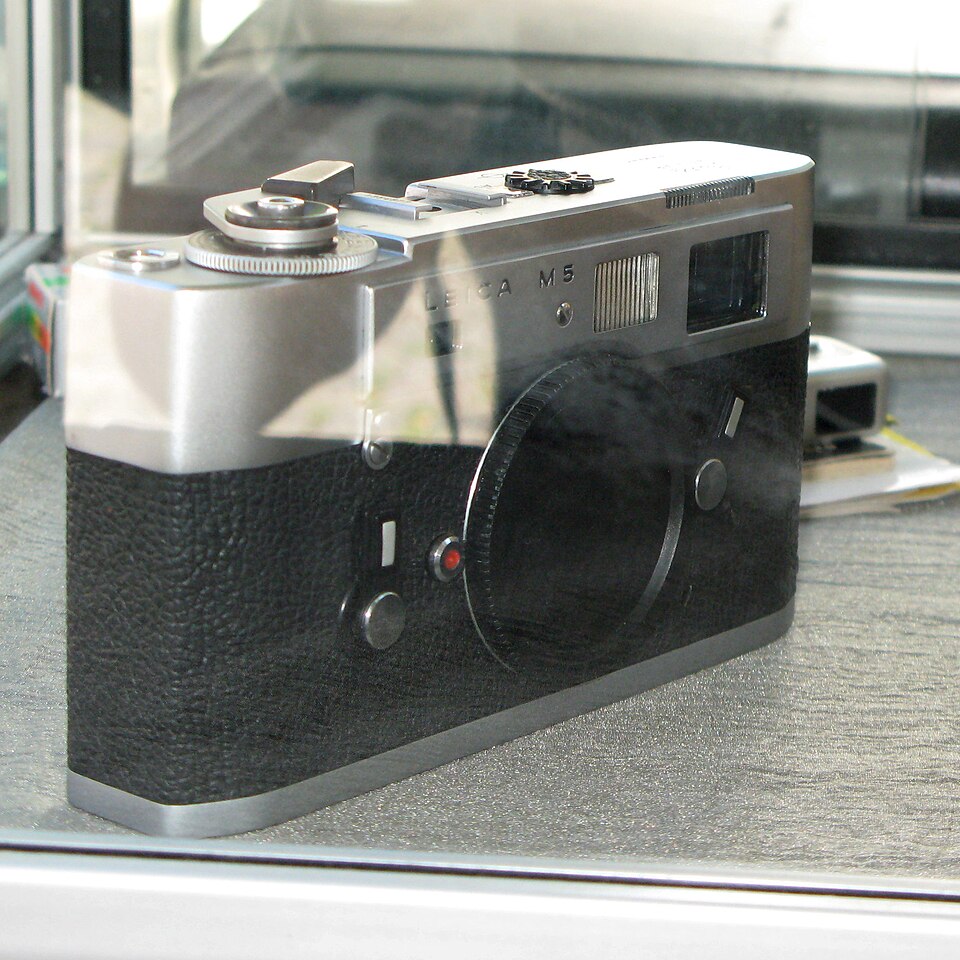
Famous for
- The controversial M with a built-in meter — rejected by purists, treasured by practitioners
- The only M body with a bottom-mounted meter cell and unique body shape
The Leica M5, introduced in 1971, was genuinely innovative: it was the first M camera with a built-in through-the-lens light meter, using a swinging CdS cell that measured light right off the shutter curtain. Technically impressive. Commercially, it was a difficult sell. The M5 body was larger than any previous M — longer and taller — to accommodate the meter mechanism, and many Leica photographers rejected it on those grounds. It simply did not look or feel like an M.
Leica discontinued the M5 in 1975 after a relatively short run. The lesson Leica took was that M photographers would accept a meter only if it did not compromise the body dimensions — a lesson directly applied to the M6, which succeeded by keeping the classic M silhouette. Today the M5 is appreciated as an interesting oddity and an excellent shooter; its meter is accurate and convenient, and used prices are often lower than equivalent M bodies because of its reputation.
Key specs
- type
- 35mm rangefinder with TTL meter
- metering
- CdS cell off shutter curtain
- shutter
- cloth focal-plane, 1s–1/1000 + B
- finder magnification
- 0.72x
- production
- ≈33,600 units (1971–1975)
Variants & finishes
The M5 in chrome — Leica's controversial 1971 M body with a swing-out light meter arm that reads off the film plane. Larger than all other M cameras; initially unpopular, now appreciated for its accurate TTL metering.
Black-chrome M5 — same in-finder TTL metering as the chrome version. The black finish is slightly less common and preferred by photographers who want a discreet look on this already-unusual body.
Market value
Used-market price (USD, estimated median)
Estimates from auction and dealer records — condition and completeness vary.
View data
| Date | Price | Source | Condition |
|---|---|---|---|
| 2016-01 | $700 | curated-estimate | user |
| 2017-01 | $700 | curated-estimate | user |
| 2018-01 | $750 | curated-estimate | user |
| 2019-01 | $800 | curated-estimate | user |
| 2020-01 | $850 | curated-estimate | user |
| 2021-01 | $950 | curated-estimate | user |
| 2022-01 | $1,100 | curated-estimate | user |
| 2023-01 | $1,300 | curated-estimate | user |
| 2024-01 | $1,450 | curated-estimate | user |
| 2025-01 | $1,600 | curated-estimate | user |
| 2026-01 | $1,650 | curated-estimate | user |
Comments
No comments yet — be the first.